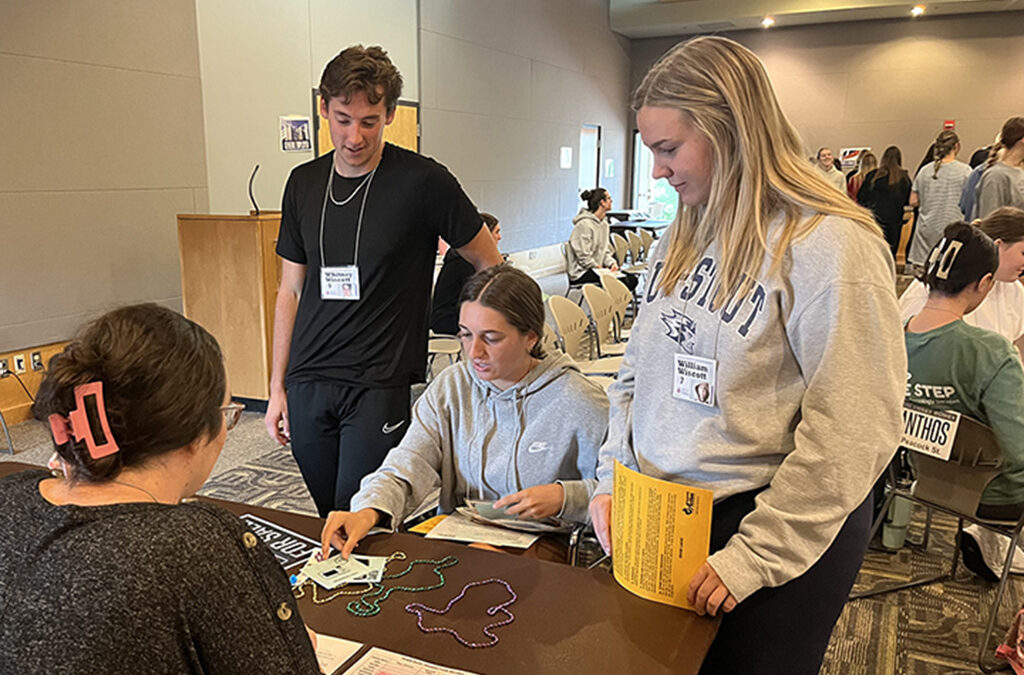
The Reeve Memorial Union ballroom was buzzing with activity on a recent morning as UW-Oshkosh nursing students hustled from table to table. As part of a simulation, some stood in line at the bank. Others pleaded with a landlord or tried to arrange childcare. A few hurried back to their “homes” clutching bus passes or overdue bills.
The stress was palpable. For three hours, 83 students weren’t nursing majors, they were role-playing families experiencing poverty and trying to survive a month’s worth of expenses and emergencies.

Heidi Hansen
It’s an exercise every traditional undergraduate nursing student at UW-Oshkosh completes. For the past 20 years, the School of Nursing and Health Professions, has run Community Action Poverty Simulation, an interactive program that helps students experience the complexities of economic insecurity.
The purpose of the exercise, said nursing instructor and two-time UWO alumna Heidi Hansen ‘92, ‘12, is to help future nurses understand how life circumstances shape health.
“Our goal is to help future nurses understand the ways in which social determinants of health influence health outcomes and to prepare them to view their patients in a holistic manner,” Hansen said. “This experience allows students to see the complexities of economic insecurity and to consider how their own attitudes and biases can shape patient care.”
Hansen knows the power of the simulation firsthand. In 2012, she was a nursing student at UWO, walking the same path. She remembers the lessons vividly.

Alyssa Smith participates in a long-standing exercise, Community Action Poverty
Simulation, that is mandatory for UWO senior nursing students.
“This exercise helps our students see patients as whole people, not just their medical conditions,” Hansen said. “The empathy they build here will serve them every day of their careers.”
The Community Action Poverty Simulation is built around detailed scenarios. Each “family” receives a packet outlining their situation: income, bills, jobs, and challenges such as childcare needs, medical issues or transportation barriers. Students step into those roles and do their best to survive four 15-minute “weeks” of living in poverty.

Polly Anderson
Around the ballroom, nursing instructors and five nursing students took on roles as bankers, utility collectors, childcare workers, employers and social service providers. There were also a quick cash loan officer and a pawn shop operator. Students must interact with them to pay bills, buy groceries, attend school and respond to unexpected crises.
Polly Anderson, simulation coordinator in the School of Nursing and Health Professions, has been co-facilitating the program since 2008. She said the lessons extend far beyond what people often think of as nursing skills.
“Nursing is a lot more than skills. We deal with people and people’s stories, and those stories contribute to what their health outcomes actually are,” Anderson said. “Maybe 90% of health outcomes have to do with the way a person lives their life. This simulation brings that reality into focus for students.”

In a simulated exercise, Taliya Orth, seated in a wheelchair, and Lily Nadolny, play a married
couple navigating disability, language barriers and raising children in poverty.
Anderson said feedback from the nursing students varies. Some students have lived in poverty themselves, while others come from privileged backgrounds. Bringing them together, she said, creates a shared learning experience that’s both eye-opening and deeply personal.
“Bringing them all into the same room brings a very unique dynamic,” she said. “If students see it as more than just an assignment, it can really influence every corner of their life, both personally and professionally.”
For many students, the exercise is stressful in ways they didn’t expect. Senior I nursing students Taliya Orth of Neenah and Lily Nadolny of Milwaukee played a married couple navigating disability, language barriers and raising children. Orth’s character was a 52-year-old father with mobility issues, who uses a wheelchair and has diabetes, while Nadolny’s was a mother with limited English working full time.
“At the start, I looked around at all the stations, the supermarket, the bank, the public school, social services, my wife’s job and tried to think through our priorities. What do I really need here to get my family to survive?” Orth said.
Nadolny said the experience gave her a new perspective.
“Being the spouse of someone with mobility challenges was eye-opening,” she said. “At first, I was so focused on going to work and making money that I neglected my husband’s needs. But later we worked together and I wheeled him everywhere. We managed to pay all our bills.”

Nursing students Adaeze Ibe-Nwagwu and Rita Nwaogaraku, said the exercise made them
aware of challenges people face and the need to connect them with resources.
Orth added that the simulation highlighted tough choices families face every day. “People really do have to decide between insulin for diabetes and food for their family, or paying utilities versus the mortgage,” she said. “It was a lot of stress and pressure.”
Nadolny connected the lesson directly to her future career.
“This experience showed me how important it is to consider what brought someone to where they are,” she said. “Patients may be upset, but they’re not upset with me personally. They may just be in a difficult place. I need to meet them where they’re at.”
Instructor Hansen said students often leave with a clearer understanding of why patients may not follow medical advice or keep appointments.
“Students report that they feel they’ll be more empathetic in their future practice,” Hansen said. “They start to appreciate why clients may not fill their prescriptions or how transportation barriers impact well-being.”
Nursing students Adaeze Ibe-Nwagwu and Rita Nwaogaraku, both from Lagos, Nigeria, said the experience gave them a new perspective.
“We often overlook how difficult it is for some people to get by every day,” Nwagwu said. “This simulation made us aware of different people’s situations and how important it is to connect them with resources.”
Nwaogaraku added: “It opened my eyes to social determinants of health. As a nurse, I need to understand that and help connect people to resources, like food pantries, that they may not even know exist.”
Anderson, who runs simulations throughout the nursing curriculum, said the poverty simulation is one of the most impactful.
“Honestly, I think this is one of the most meaningful exercises we offer at both a personal and professional level,” she said. “It’s not healthcare specific. Any profession could benefit from learning to put yourself in someone else’s shoes.”
Hansen agrees. More than a decade after her own turn in the simulation, she said the lessons still resonate.
“When you’ve felt that stress, even in a simulation, you can’t forget it,” she said. “It changes the way you see people, and that’s what makes you a better nurse.”
The takeaway, Hansen said, is simple.
“Health care isn’t just about treating illness,” she said. “It’s about understanding the lives behind the patients we serve.”
Learn more:
Written by Grace Lim
Link to original story: https://www.uwosh.edu/today/128532/uw-oshkosh-nursing-students-mark-20-years-learning-through-poverty-simulation/